Transforming Early Literacy with Funny Face Tracing: A Visual Approach to Alphabet Mastery
The journey of learning to read and write is one of the most significant developmental milestones in a child’s life. For educators, parents, and caregivers, finding tools that bridge the gap between rigorous educational standards and genuine childhood engagement is often a challenge. Traditional methods of alphabet instruction, while effective for some, can sometimes feel repetitive or abstract to young learners who thrive on visual stimulation and play. This is where innovative design solutions come into play, reshaping how we approach early literacy materials. Among these emerging resources, Funny Face Tracing stands out as a distinctive tool that merges pedagogical utility with whimsical creativity.
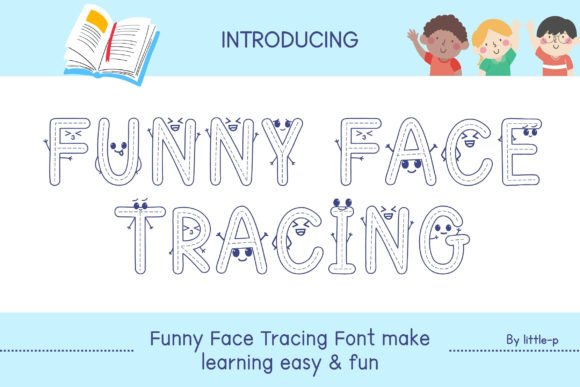
This unique alphabet tracing font is not merely a stylistic choice; it is a carefully crafted educational asset designed to capture the attention of young minds. By integrating amusing facial expressions into each letterform, the font transforms static characters into dynamic, relatable entities. This article explores the mechanics, benefits, and practical applications of this approach, offering insights for those involved in early childhood education, content creation, and homeschooling environments.
The Psychology Behind Visual Engagement in Learning
To understand why a font like Funny Face Tracing is effective, one must first consider how children process information. Young learners are naturally drawn to faces. From infancy, humans are wired to recognize and interpret facial expressions as a primary mode of communication. When letters are presented with distinct personalities through eyes, mouths, and expressions, they become more than just abstract symbols; they become characters with which a child can interact emotionally.
This anthropomorphism serves a critical cognitive function. It aids in memory retention by creating stronger neural associations. When a child traces the letter "A" and sees a surprised or happy expression, the brain links the motor action of tracing, the visual shape of the letter, and the emotional context of the face. This multi-sensory engagement is far more potent than rote memorization. The delightful and engaging appearance of the font ensures that practice sessions do not feel like chores, but rather like playful interactions, thereby reducing resistance to learning tasks.
Design Features That Support Letter Recognition
The core functionality of Funny Face Tracing lies in its balance between clarity and creativity. For a tracing font to be educationally viable, it must maintain the structural integrity of standard alphabet forms. If a letter is too distorted by decorative elements, it may confuse learners rather than help them. This font is tailored to help children practice letter recognition skills by ensuring that the underlying skeleton of each letter remains true to conventional printing standards.
Each letter features amusing facial expressions that are integrated seamlessly into the strokes. For instance, the curves of a "C" or an "S" might form a smile, while the vertical lines of an "H" could serve as the frame for wide, curious eyes. These design choices are not random; they are calculated to highlight the unique geometry of each character. By emphasizing the specific shapes that differentiate one letter from another, the font reinforces visual discrimination skills. This is particularly beneficial for children who may struggle with distinguishing similar-looking letters, such as "b" and "d" or "p" and "q."
Enhancing Fine Motor Skills Through Enjoyable Practice
Beyond visual recognition, handwriting development requires the refinement of fine motor skills. Tracing is a foundational exercise that helps children develop the hand-eye coordination and muscle memory necessary for independent writing. However, the effectiveness of tracing depends heavily on the child’s willingness to repeat the activity. Repetition is key to mastery, but it can quickly lead to boredom if the material is dull.
With Funny Face Tracing, the entertaining design encourages prolonged engagement. Children are more likely to complete entire worksheets when they are motivated by the desire to see the next funny face. This increased volume of practice directly correlates with improved pen control and stroke consistency. Teachers and caregivers will appreciate this aspect, as it reduces the need for constant external motivation and allows for more autonomous learning experiences.
Practical Applications in Educational Settings
The versatility of this font makes it suitable for a wide array of educational contexts. Its perfectly suited nature for young learners means it can be adapted for various formats, from digital apps to printed handouts. Below are several key areas where Funny Face Tracing can be effectively implemented.
- Classroom Worksheets: Teachers can create custom activity sheets that combine tracing with coloring. Since the faces are expressive, students can color them according to the emotion displayed, adding an art component to literacy lessons.
- Homeschool Curricula: For parents educating their children at home, this font provides a structured yet fun way to introduce the alphabet. It can be used in daily morning routines or as part of a broader language arts program.
- Special Education Resources: Children with learning differences, such as dyslexia or ADHD, often benefit from multi-sensory and highly engaging materials. The distinct visual cues provided by the facial expressions can aid in differentiation and focus.
- Interactive Learning Materials: Digital educators can use the font in interactive whiteboard activities or tablet-based apps where children trace the letters with their fingers, receiving immediate visual feedback through the animated expressions.
Considerations for Educators and Content Creators
While the benefits of using a specialized font like Funny Face Tracing are clear, it is important to integrate it thoughtfully into a broader educational strategy. It should not replace exposure to standard typography entirely. Instead, it serves as a scaffold—a temporary support structure that helps beginners build confidence and competence. As children progress, educators should gradually introduce more traditional fonts to ensure a smooth transition to standard reading materials.
Furthermore, the quality of the accompanying materials matters. When designing worksheets or learning modules, ensure that there is adequate spacing between letters to prevent visual clutter. The amusing facial expressions should be prominent but not so overwhelming that they distract from the letter shape itself. Balance is crucial. The goal is to promote interactive learning experiences among children without sacrificing educational rigor.
Creating a Holistic Learning Environment
Integrating this font into your teaching toolkit is just one step toward creating a holistic learning environment. It works best when combined with verbal reinforcement, storytelling, and physical activities. For example, after tracing the letter "B" with its bubbly expression, a teacher might ask students to make a big, bold sound or act out a bouncing ball. This kinesthetic connection reinforces the visual and motor skills practiced during tracing.
Content creators and designers who develop educational resources should also consider the accessibility of their materials. Ensure that printed versions have high contrast and that digital versions are compatible with various screen sizes. The inclusive design of Funny Face Tracing makes it a valuable asset for diverse classrooms, but its impact is maximized when used in conjunction with other inclusive teaching practices.
The Future of Playful Typography in Education
The rise of fonts like Funny Face Tracing reflects a broader trend in educational design: the recognition that learning does not have to be sterile to be serious. As research continues to highlight the importance of emotional engagement in cognitive development, we can expect to see more tools that prioritize joy and curiosity. This font represents a shift away from one-size-fits-all approaches toward more personalized, engaging, and effective learning aids.
For schools, kindergartens, and home school environments, adopting such tools signals a commitment to modern, child-centered pedagogy. It acknowledges that children are not empty vessels to be filled with facts, but active participants in their own learning journeys. By providing materials that respect their need for play and imagination, educators can foster a lifelong love of learning.
In conclusion, Funny Face Tracing offers a compelling solution for those seeking to enhance early literacy instruction. Its combination of educational value and entertaining design makes it an excellent choice for promoting interactive learning experiences. Whether you are a teacher looking to refresh your classroom resources, a parent seeking engaging homeschool materials, or a designer creating the next generation of educational products, this font provides a unique opportunity to make alphabet learning both effective and enjoyable. By leveraging the power of visual storytelling and playful design, we can help young learners build a strong foundation for future academic success.