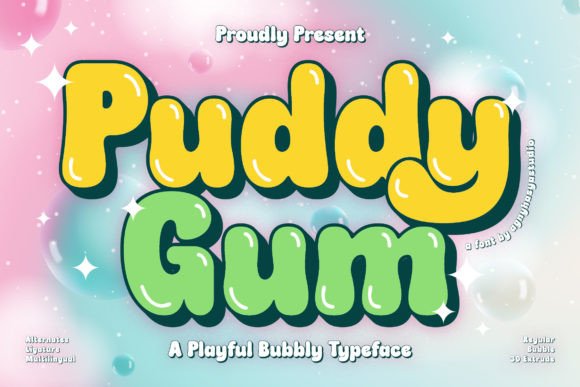
Puddy Gum: A Playful and Versatile Display Typeface for Modern Branding
In the crowded landscape of digital typography, finding a display font that balances whimsy with professional usability can be a challenge. Designers often face a trade-off between personality and legibility, or between unique character sets and technical robustness. Puddy Gum emerges as a compelling solution in this space, offering a distinct aesthetic that is simultaneously groovy, bubbly, and structured. This typeface family is not merely a decorative element; it is a comprehensive typographic tool designed to meet the diverse needs of modern creative projects.
At its core, Puddy Gum is a display typeface that leans heavily into soft, rounded forms and a playful energy. However, what sets it apart from many novelty fonts is its depth. The family includes three primary styles—Regular, Bubble, and Outline 3D Extrude—along with corresponding italics. This variety allows designers to create visual hierarchy and interest within a single project without needing to source multiple unrelated fonts. Whether you are working on a logo for a startup, designing packaging for a consumer product, or creating social media assets, Puddy Gum provides the flexibility required to maintain brand consistency while injecting personality.
Deconstructing the Aesthetic and Technical Features
The visual identity of Puddy Gum is defined by its "fluffy" and fun appearance. The letterforms are characterized by generous curves and a lack of sharp angles, which evokes a sense of approachability and warmth. This makes the font particularly effective for brands that want to appear friendly, youthful, or innovative. The Regular style serves as the foundation, offering clean readability despite its decorative nature. The Bubble style amplifies the playful aspect, adding volume and presence that commands attention, ideal for headlines or short impact statements. Meanwhile, the Outline 3D Extrude style introduces a retro-modern dimensionality, perfect for creating depth in posters and banners.
Beyond its visual appeal, the technical construction of Puddy Gum demonstrates a high level of craftsmanship. One of its most significant strengths is the inclusion of PUA (Private Use Area) Unicode support. This feature is crucial for professional workflows, as it ensures that special characters, alternates, and ligatures are accessible across various design software and operating systems without compatibility issues. For freelancers and agencies working with clients who may use different platforms, this reliability is invaluable.
The font family also boasts extensive multilingual support, covering uppercase and lowercase letters, numerals, and a full range of punctuation. This inclusivity means that Puddy Gum is not limited to English-language projects. It can effectively serve global brands or local businesses targeting diverse demographics. The inclusion of carefully crafted alternates and ligatures further enhances its utility. These features allow for custom typographic treatments, enabling designers to avoid repetitive patterns and create unique wordmarks that stand out in competitive markets.
Practical Applications in Design Workflows
When evaluating a typeface for professional use, it is essential to consider how it performs in real-world scenarios. Puddy Gum excels in contexts where visual engagement is paramount. For logos and branding, the ability to layer the three styles offers a distinct advantage. Because the characters overlap and align perfectly, designers can stack the Regular, Bubble, and Outline styles to create complex, multi-dimensional logotypes. This technique adds visual weight and sophistication without requiring advanced illustration skills.
In advertising and marketing materials, such as posters and banners, the font’s bold presence ensures that messages are noticed. The 3D Extrude style, in particular, works well for promotional headers where grabbing immediate attention is the goal. For product packaging, the friendly aesthetic of Puddy Gum can influence consumer perception, suggesting that the product inside is enjoyable, safe, or premium in a playful way. This is especially relevant for industries like confectionery, children’s products, beauty, and lifestyle goods.
Furthermore, the font is highly effective for social media content and digital art quotes. In an era where scroll-stopping visuals are critical, the bubbly and groovy nature of Puddy Gum helps break through the noise. Its legibility at various sizes ensures that text remains readable on mobile devices, while its stylistic flair encourages sharing and engagement. Educators and publishers might also find value in using Puddy Gum for materials aimed at younger audiences, where a less formal, more inviting tone is appropriate.
Evaluating Usability and Long-Term Value
From a usability perspective, Puddy Gum is designed to integrate seamlessly into existing design workflows. The consistent spacing and alignment across all three styles mean that switching between them does not require manual adjustment of kerning or tracking in most cases. This efficiency saves time during the iterative design process, allowing creators to experiment rapidly with different combinations. For small business owners and entrepreneurs who may not have extensive design experience, this ease of use lowers the barrier to creating professional-looking materials.
The long-term value of investing in a font like Puddy Gum lies in its versatility. Unlike narrow niche fonts that may only suit a single project type, Puddy Gum’s range of styles allows it to adapt to evolving brand needs. A company might start with the Regular style for internal communications and later adopt the Bubble or 3D styles for major campaigns, maintaining a cohesive visual language throughout. This scalability makes it a cost-effective asset for growing businesses.
However, it is important to acknowledge limitations. As a display typeface, Puddy Gum is not intended for long-form body text. Its decorative nature can reduce readability in dense paragraphs. Therefore, it should be paired with a neutral sans-serif or serif font for extended reading materials. Understanding this boundary is key to using the font effectively. When used appropriately for headlines, titles, and short bursts of text, it performs exceptionally well.
Who Benefits Most from Puddy Gum?
This typeface is particularly well-suited for graphic designers and illustrators who need reliable, high-quality assets for client work. The PUA Unicode support and multilingual capabilities make it a safe choice for international projects. Marketers and brand managers will appreciate the font’s ability to convey specific emotional tones—joy, creativity, and informality—which can strengthen brand connection with target audiences.
Freelancers and hobbyists will also find Puddy Gum to be a valuable addition to their toolkit. The pre-made styles reduce the need for complex effects in software like Photoshop or Illustrator, streamlining the creation of eye-catching graphics. Additionally, educators and content creators who produce materials for younger demographics or casual learning environments can leverage the font’s approachable aesthetic to make content more engaging.
In conclusion, Puddy Gum represents a thoughtful blend of artistic expression and technical precision. It addresses the common pain points of display typography by offering consistency, flexibility, and broad compatibility. For professionals seeking a font that can deliver both playful charm and structural reliability, Puddy Gum is a worthy consideration. Its ability to enhance logos, packaging, and digital media while maintaining ease of use ensures that it remains a relevant and effective resource in contemporary design practice.